What “living on the knife edge” really means
Peak Performance in Endurance Sports: Stress, Recovery, Cortisol & Training Balance Explained
Most athletes believe performance is built by pushing harder — but the real gains happen in the space between stress and recovery. This article breaks down how to operate on that knife-edge, where adaptation happens, and performance is created. If you want to understand why doing more is not always better, this will change how you train.

Performance on the Knife Edge: Why Balance, Not Brutality, Drives Peak Results
“Cortisol plays a crucial role in energy metabolism and recovery.”
That statement is often misunderstood. In performance culture, cortisol is frequently labelled as something negative — a stress hormone to reduce or avoid. In reality, it is one of the very systems that allows you to perform at a high level.
The real problem is not cortisol.
The problem is losing control of the system that regulates it.
The Reality of High Performance
Serious athletes do not live in balance in the traditional sense. They don’t operate in comfort, moderation, or steady states.
They live on a knife edge.
This edge sits between two worlds:
- Adaptation and growth
- Breakdown and overload
Push too little, and nothing changes.
Push too much, for too long, and the system collapses.
Peak performance exists in a narrow, dynamic space where stress is high enough to stimulate adaptation, but recovery is strong enough to absorb it.
That space is not stable.
It requires constant regulation.
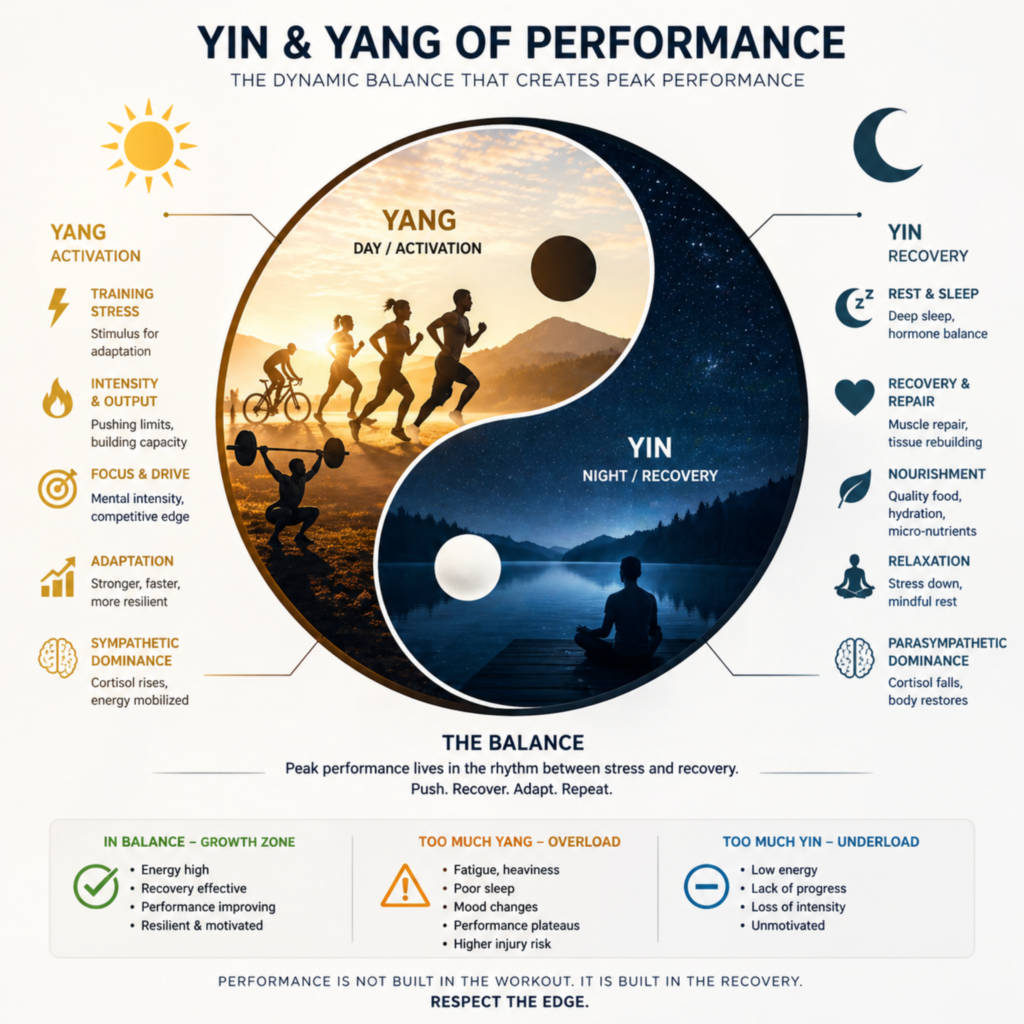
Yin and Yang — Chinese Philosophy in relation to Physiological Reality
The ancient concept of yin and yang describes opposing but interdependent forces: activity and rest, tension and release, output and recovery.
In modern physiology, this maps directly onto:
- Sympathetic activation (yang)
Training, competition, intensity, cortisol, adrenaline - Parasympathetic activation (yin)
Recovery, sleep, repair, hormonal balance
Performance is not determined by how much you train.
It is determined by how well you oscillate between these two states.
Athletes who stay too long in “yang” — constant output, constant pressure — will eventually pay the price.
Cortisol: The Misunderstood Performance Hormone
Cortisol is essential for performance:
- It mobilizes energy
- Supports high-intensity output
- And helps you respond to stress
Without cortisol, there is no adaptation.
But the system is designed for rhythm:
- Cortisol should rise when you train
- It should fall when you recover
The issue begins when:
- Stress is continuous
- Recovery is insufficient
- The system no longer switches off
This is where athletes move from functional overreaching into dysregulation.
Where Athletes Go Wrong
Most high performers are extremely disciplined in training.
They track sessions, power, zones, intervals.
But they often ignore the other side of the equation.
Common patterns:
- stacking intensity without true recovery
- high cognitive and emotional stress outside training
- inconsistent fueling
- poor sleep quality despite enough hours
- inability to mentally “switch off”
The result is subtle at first:
- performance plateaus
- fatigue becomes persistent
- recovery feels incomplete
And the instinct is often:
→ push harder
The Knife Edge in Practice
Living on the knife edge does not mean constantly pushing your limits.
It means:
- you approach your limits strategically
- you cross them briefly
- and you return from them effectively
The difference between peak adaptation and breakdown is often not intensity — it is duration and recovery capacity.
You can go beyond your limit.
You just cannot stay there.
How to Recognize Your Position
The body gives early signals long before injury or illness.
Signs you are in the optimal zone:
- performance is stable or improving
- fatigue is present but manageable
- motivation remains intact
- recovery feels effective
Signs you are drifting out of balance:
- sleep becomes lighter or fragmented
- legs feel heavy without clear reason
- mood shifts (irritability, flatness)
- performance stagnates or drops
- you feel “wired but tired”
These are feedback signals, not weaknesses.
Managing the Edge
High performance is not about doing more.
It is about managing stress and recovery with precision.
That includes:
- structuring true high and low days
- prioritizing sleep quality, not just duration
- fueling in alignment with training demands
- reducing unnecessary stress load
- allowing the nervous system to downregulate
Discipline is not constant intensity.
Discipline is the ability to adjust before the system breaks.
The Shift That Changes Everything
Most athletes believe:
“I get better because I train hard.”
But the reality is:
You get better because you adapt to training.
And adaptation only happens when the body is given the conditions to recover, rebuild, and respond.
Final Thought
The best athletes are not the ones who push the hardest.
They are the ones who manage the knife edge most precisely.
They understand when to apply stress.
And when to step back and let the body do its work.
Because performance is not built in the moment of effort.
It is built in the space that follows it.