Engine Size vs. Power: Understanding the Two Levers of Endurance: Vo2max and Vlamax
Why can two athletes with the same “aerobic engine” (VO2max) have completely different race results? Why does one athlete burn through fuel while the other seems to have a bottomless tank? The answer lies in the interaction between two powerful levers: the engine and the turbo.
Unravel the metabolic mystery – Let’s look under the hood.
Beyond the Buzzwords: Exploring VO₂max and VLamax as Key Endurance Factors
For too long, endurance metrics have been treated like buzzwords. We hear about VO₂max, FTP, and lactate thresholds, yet rarely do we receive a clear, physiological explanation of why they matter and, more importantly, how they interact.
Today, we’re dissecting the powerful duo: VO₂max and VLamax. Forget the jargon; let’s talk about the engine and the turbo.
1. VO₂max: Your Aerobic Ceiling and your Engine Size
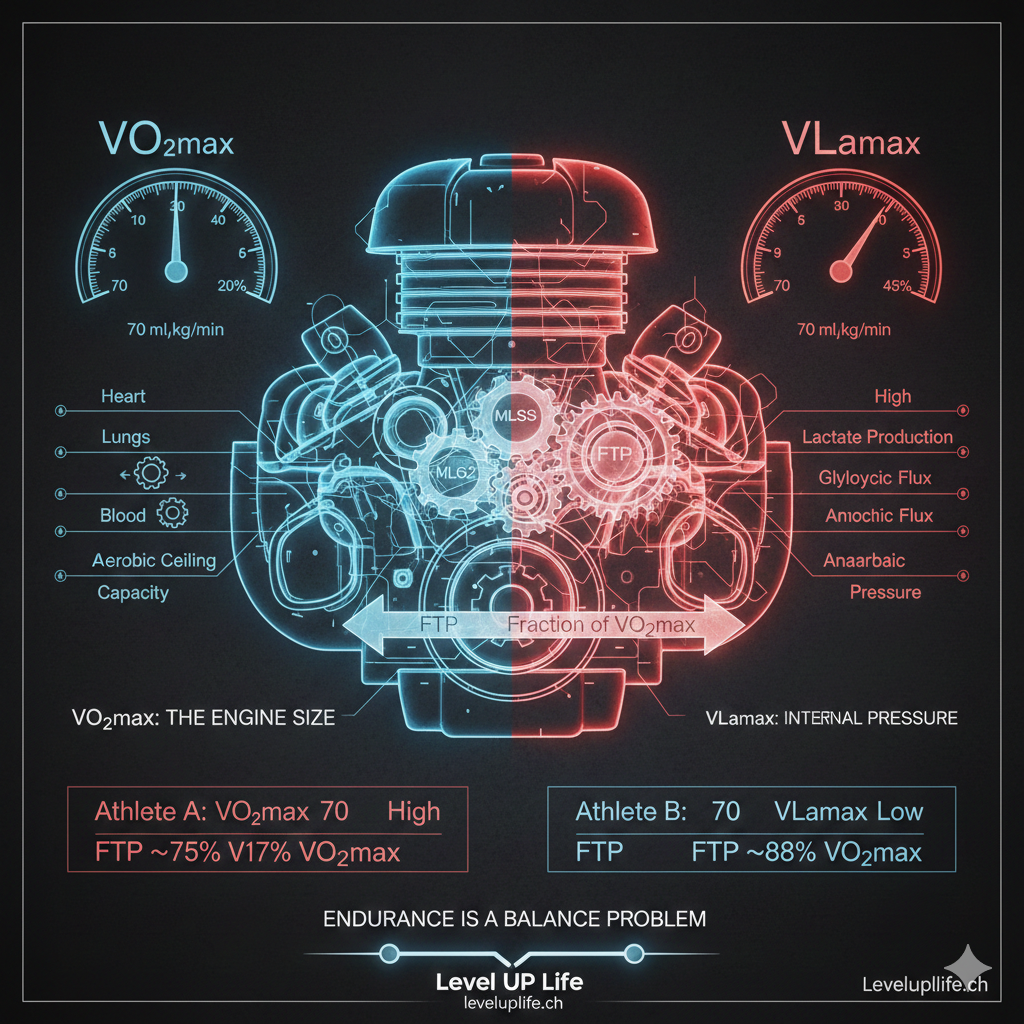
Imagine your body as a high-performance vehicle. VO₂max is the size of its engine. It represents the maximal rate at which your body can deliver, extract, and utilize oxygen. This includes the efficiency of your heart, lungs, and blood in transporting oxygen and the capacity of your muscles’ mitochondria to convert it into energy.
Why VO₂max sets the ceiling: Every submaximal performance marker you care about – your FTP (Functional Threshold Power), your lactate thresholds (LT1, LT2), and your fat and carbohydrate oxidation peaks – sits below your VO₂max. They are a fraction of this maximum capacity.
If you increase your VO₂max, all else being equal, the absolute power or speed you can sustain at these critical thresholds will also increase. Consider the following:
- Athlete A: VO₂max = 55 ml/kg/min
- Athlete B: VO₂max = 70 ml/kg/min
Even if both athletes work at 80% of their VO₂max, Athlete B will produce significantly more absolute power because their engine is simply larger. VO₂max undeniably defines your aerobic ceiling and anchors your absolute performance potential.
Let’s Deep Dive a bit: How a Higher Ceiling (VO₂max) Changes Everything
When you increase your VO₂max, you aren’t just improving one metric—you are creating an “upward ripple” across your entire metabolic system. A higher aerobic capacity allows for a greater flow of oxygen, which triggers these four key shifts:
1. The Threshold Bump (MLSS): Your “steady state” moves to a higher absolute power or pace. You can now hold a faster speed with the same level of effort.
2. The Lactate Shift: Your lactate curve shifts to the right. This means you can go faster before lactate even begins to rise (higher LT1), staying “fresher” for much longer.
3. The Fat-Burning Upgrade (FatMax): Your absolute capacity to burn fat increases. At a pace that used to require sugar (glycogen), you can now fuel yourself primarily with your near-limitless fat stores.
4. The Carb Efficiency (CarbMax): You can perform more work before hitting your carbohydrate limit. This means you can climb faster or run harder without “bonking” or needing to constantly refuel.
2. Why VO₂max Alone Isn’t Enough
This is where many people stop, and where critical training mistakes begin. Two athletes can have the exact same VO₂max but wildly different performance outcomes: Vastly different FTPs, marathon paces, fat oxidation rates, durability, and ultimately, race results.
Why? Because peak performance isn’t decided at your VO₂max; it’s decided at the sustainable intensities below it. This brings us to the crucial missing variable.
3. VLamax: Glycolytic Power (The “Turbo”)
If VO₂max is the size of your engine, VLamax is the intensity of your internal “turbo.” It represents your peak power —the glycolytic system, your ability to sprint and move with explosive force. But in the world of endurance, your turbo has a cost. VLamax determines how much your anaerobic system “turns on” during your workout.
How it works in simple terms:
- A High VLamax is like a high-performance turbo. It gives you incredible speed and power (think: sprinting for the finish line), but it burns through your battery/fuel incredibly fast and produces a lot of “heat” (lactate).
- A Low VLamax is like a highly efficient hybrid engine. It might not have that explosive top speed, but it’s designed to sip fuel and keep going for hours without overheating.
The Secret to Endurance: You don’t want a “broken” turbo, but for long races, you want a controlled, economical one. If your VLamax is too high, your body is essentially “sprinting” internally even when you are trying to pace yourself, which is why you hit the wall sooner.
VLamax isn’t a measure of quality, but a measure of character: It tells you if your engine is tuned for a 100-meter drag race or a 150-km road trip.
What VLamax actually does:
VLamax dictates:
- How quickly lactate accumulates at a given workload.
- How early your body shifts towards carbohydrate dominance for fuel.
- How much fat oxidation is suppressed.
- How soon you are forced to reduce your intensity.
Lactate isn’t the enemy; inefficiency is. Performance isn’t limited by lactate, but by your body’s tendency to over-produce it before you even reach your top speed.
Key findings: Monthly adaptations for VLamax are typically small, with most changes remaining below ~0.1 mmol·L⁻¹·s⁻¹ . Long-term training consistency is therefore essential, as meaningful changes in VLamax accumulate over extended training periods.
4. The Critical Interaction: Why % of VO₂max Matters More
Sustainable intensity, like your Maximal Lactate Steady State (MLSS) or FTP, is essentially about how much of your VO₂max you can utilize continuously. This crucial fraction is strongly shaped by your VLamax.
High VLamax:
- Leads to higher glycolytic flux.
- Results in earlier lactate accumulation.
- Strongly inhibits fat oxidation.
- Consequently, your MLSS occurs at a lower percentage of your VO₂max.
- Result: High peak power and strong anaerobic contributions, but poor sustainability.
Low VLamax:
- Indicates restrained glycolytic flux.
- Results in slower lactate appearance.
- Promotes better fat oxidation.
- Shifts your MLSS to a higher percentage of your VO₂max.
- Result: Lower sprint power, but excellent durability and a higher sustainable fraction of your VO₂max.
Consider two athletes with the same VO₂max but different VLamax levels:
| VO₂max | VLamax | Outcome |
| 70 | High | FTP ~75% of VO₂max |
| 70 | Low | FTP ~85–88% of VO₂max |
That 10-13% difference in sustainable power is absolutely race-defining.
5. Fueling Decisions: Fat & Carbohydrate Benchmarks
Beyond just power, VLamax is the hidden lever of metabolic efficiency – it dictates exactly how much fat versus sugar you burn at any given speed.
Fat Oxidation:
- High VLamax: Increased glycolysis leads to more pyruvate and acetyl-CoA, which in turn inhibits the entry of fat into the mitochondria. This means your peak fat oxidation occurs earlier and drops off faster, limiting long-duration performance.
- Low VLamax: Fat oxidation remains high at higher intensities, sparing your precious glycogen stores and dramatically improving durability.
Carbohydrate Reliance: VLamax doesn’t just affect how much carbohydrate you burn; it dictates how early you are forced to burn it. This explains why two athletes at the same power output can have completely different fuel costs and reach their “blow-up” point at different times.
6. Thresholds as Emergent Properties
Here’s the key conceptual leap: MLSS, LT1, and LT2 are not standalone systems that you train directly. They are emergent properties that arise from the intricate interplay of:
- VO₂max (your aerobic capacity)
- VLamax (your glycolytic pressure /Turbo )
- Mitochondrial density
- Lactate clearance mechanisms
This means that simply raising your VO₂max without managing your VLamax might not improve your endurance. Conversely, lowering your VLamax without a sufficient VO₂max might cap your absolute performance potential.
Endurance is always a balance problem, not a maximization problem.
7. More Metrics Don’t Mean Better Endurance
Collecting endless metrics like FTP, LT1, LT2, HRV, power curves, and zone data without understanding which limiter dominates your current performance inevitably leads to random, inefficient training.
The real questions you need to ask are:
- Is my performance capped by my aerobic ceiling (VO₂max)?
- Or by an inefficient use of that ceiling (VLamax too high for my goals)?
- Or by both, perhaps at different points in my training cycle or racing season?
8. The Core Insight: Balancing Your Levers
Improving endurance isn’t about indiscriminately raising every number. It’s about identifying which physiological pressure is currently limiting your performance and strategically adjusting your training to address it.
- VO₂max sets how high you could go.
- VLamax determines how much of that height you can actually use sustainably.
Endurance performance truly lives in the interaction between these two metrics, not in either one alone.
Understanding this fundamental relationship allows you to move beyond generic training plans and implement precise, data-driven strategies to unlock your true endurance potential. If you need guidance in that process, reach out, and we will P.E.A.K your Training.
Key Takeaways: Capacity vs. Efficency
- The Two-Lever Rule: True endurance isn’t about one number; it’s about the balance between your Aerobic Ceiling (VO₂max) and your Internal Turbo (VLamax).
- The Great Regulator: VLamax isn’t just for sprinters. It is the master switch that dictates how much of your aerobic engine you can actually use before “overheating.”
- Capacity vs. Efficiency: VO₂max defines your Aerobic Ceiling (How high could you go?). VLamax determines your Utilization (How much of that height can you actually use?).
Performance isn’t about maximizing one; it’s about balancing both.