What most athletes overlook and why it impacts your performance
Getting beyond carbs and electrolytes – The Deep dive into Sports Drinks
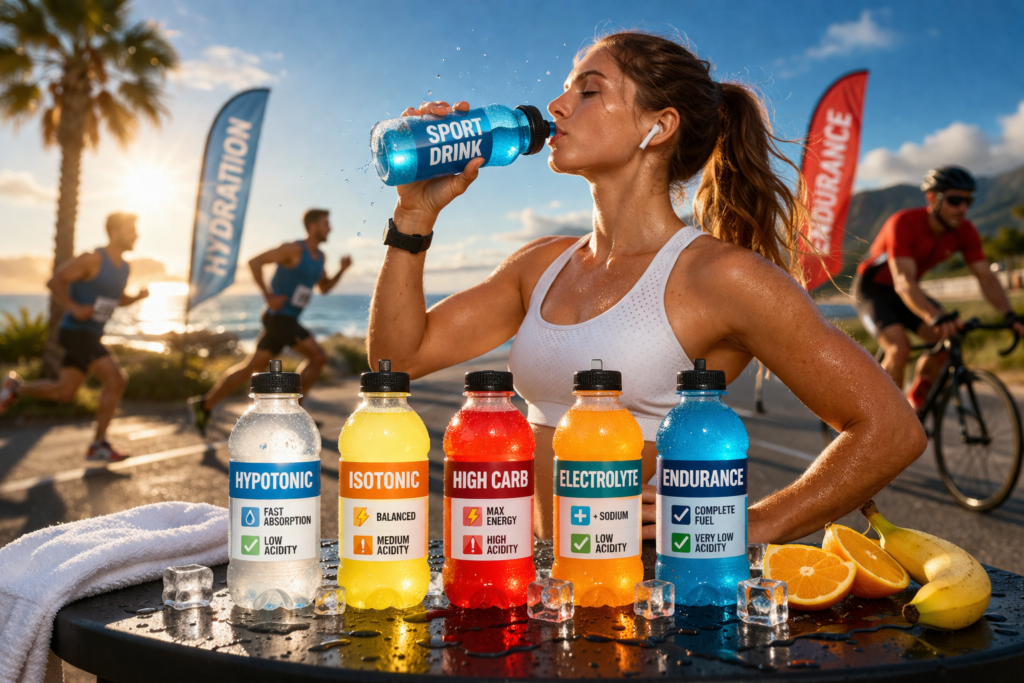
The Hidden Difference That Impacts Your Performance
Most athletes approach sports nutrition with a simple question: How many carbs do I need? But in practice, performance rarely breaks down because of a lack of fuel. It breaks down when the body can’t properly absorb or tolerate what it’s given.
Behind every sports drink are two often overlooked factors — osmolality and acidity — that determine whether your fueling strategy actually works under load. Understanding this difference is what separates a plan that looks good on paper from one that performs in real life.
Osmolality and acidity in sports drinks
Behind every sports drink are two factors most athletes never look at:
Osmolality and acidity
These two variables determine how your drink behaves once it enters your system.
- Osmolality controls how quickly fluids and carbohydrates move from your stomach into the bloodstream. It directly affects absorption speed and fuel delivery.
- Acidity determines how much stress your gut has to handle while processing that drink. It influences tolerance, comfort, and how long your system is exposed to that load.
In simple terms:
Osmolality decides how well you absorb fuel.
Acidity decides whether you can tolerate it in the first place.
And this is exactly where many fueling strategies break down.
Most athletes focus on one variable: carbohydrates.
But performance nutrition is not just about how much you take in —
it’s about what your system can actually handle under stress.
Why this matters more than you think
Many popular sports drinks look similar on the surface.
But when you analyze them deeper , the differences are significant:
- Maurten, Sponser Competition, Winforce Basic Plus
→ very low acidity = less stress for the body - PowerBar and some isotonic drinks
→ high acidity = high stress
Despite this, their pH values can look very similar.
And that’s exactly where most athletes misunderstand the topic.
pH vs. acidity — the difference that changes everything
Most people assume:
low pH = high problem
But that’s not the full story.
pH = The intensity of acidity
- how sharp the impact feels
- a snapshot in time
Acidity = total acid load
- how much acid your body must neutralize
- cumulative stress on your system
Simple way to understand it
pH = how aggressive the hit is
Acidity = how long and how much your system has to deal with it
Think of it like this:
- A drink can be very acidic (low pH) but contain little total acid → this is easy for your body to handle.
- Another can feel similar but contain a large acid load → that’s much harder for your body.
Why this directly affects performance
Two systems are always working in parallel:
1. Carbohydrate absorption – The performance driver
To sustain performance, you need:
- high carb intake
- fast absorption
→ This is influenced by osmolality.
Best case:
hypotonic to isotonic drinks
→ faster gastric emptying
→ efficient fuel delivery
2. Gut tolerance – limiting factor
This is where acidity becomes critical.
High acidity means:
- more buffering required
- longer exposure in stomach and mouth
- higher stress on the gut
→ leading to:
- nausea
- discomfort
- reduced intake
Want to optimize your Fueling, Gut Tolerance, and Metabolic Setup? Let’s build a System, not just your plan. Find out more here.
The real problem in endurance performance
When we talk about sports drinks and fueling, performance is not limited by carbs themselves.
It’s determined by how well your system can tolerate and use them.
Example scenarios:
High carbs + high acidity
→ gut overload
→ intake drops
→ performance drops
Optimized system (low acidity + correct osmolality)
→ stable gut
→ consistent fueling
→ sustained output
Osmolality vs Hydration and Gut Tolerance
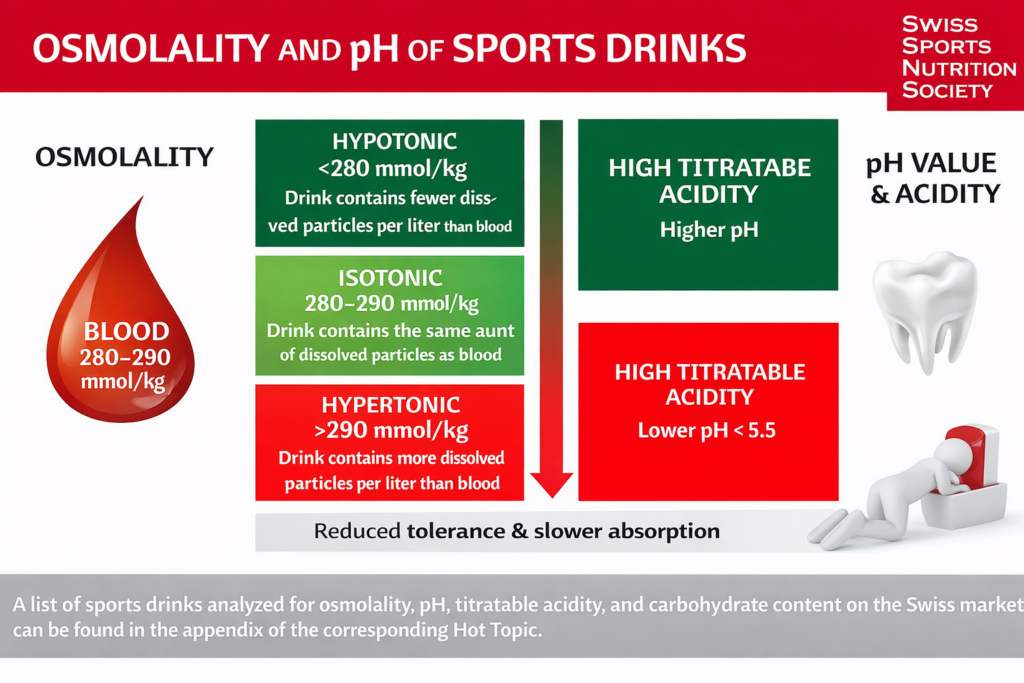
Hypotonic, Isotonic, Hypertonic – what it means
These terms describe how concentrated a drink is compared to your blood.
Hypotonic
Lower concentration than your blood
→ fluids move quickly into the bloodstream
→ fast hydration, easy on the gut
Best for: hydration, high intensity, sensitive gut
Isotonic
Similar concentration to your blood
→ balanced fluid and carbohydrate delivery
→ moderate absorption speed
Best for: general endurance fueling
Hypertonic
Higher concentration than your blood
→ draws water into the gut
→ slower absorption, higher GI stress risk
Best for: energy delivery outside of intense effort (or when diluted properly)
Simple takeaway:
- Hypotonic → hydration
- Isotonic → balance
- Hypertonic → fuel (but higher gut load)
Brand comparison in practice
More gut-friendly
→ low acidity → better tolerance at intensity
Potentially problematic under load
- PowerBar Iso / Isolite
- some ready-to-drink isotonic beverages
→ high acidity → higher risk of GI stress
Why this matters even more during exercise
During training or racing:
- blood flow to the gut decreases
- stress hormones increase
- digestive capacity drops
→ your system becomes more sensitive
A drink that feels fine at rest can become a limiting factor at race intensity.
Additional factor: dental health
- pH < 5.5 → enamel damage
- high acidity → longer exposure
That’s especially relevant for athletes sipping drinks over hours.
Practical takeaways
1. Look beyond carbohydrates
Also consider:
- osmolality
- acidity
2. Test under real conditions
Not at rest
→ test in long sessions, race pace and heat
3. If you struggle with your gut
Check:
- acidity load
- drink concentration (osmolality)
4. Build your system, not just your plan
Performance is a system:
- physiology
- gut function
- fueling strategy
- product choice
Want to optimize your Fueling, Gut Tolerance, and Metabolic Setup? Let’s build a System, not just your plan. Find out more here.
Use the code Leveluplife at checkout on www.sportbenzin.com and receive 10% off your order.