
Cycle-Based Training:
How to Use Your Hormones as a Performance Boost
Women are not “small men.” What has been ignored in sports science for years is now coming into focus: the female cycle is not a limitation to athletic performance, but a powerful tool for optimization. Those who understand how hormones like estrogen and progesterone influence metabolism, strength, and recovery don’t just train healthier—they train more effectively.
In this article, we show you how to move away from rigid training plans and start training in alignment with your cycle — and why the health of your period is the most important indicator of your performance curve.

The 5 Key Principles of Cycle-Based Training
The Biological Map: More Than Just “Your Period”
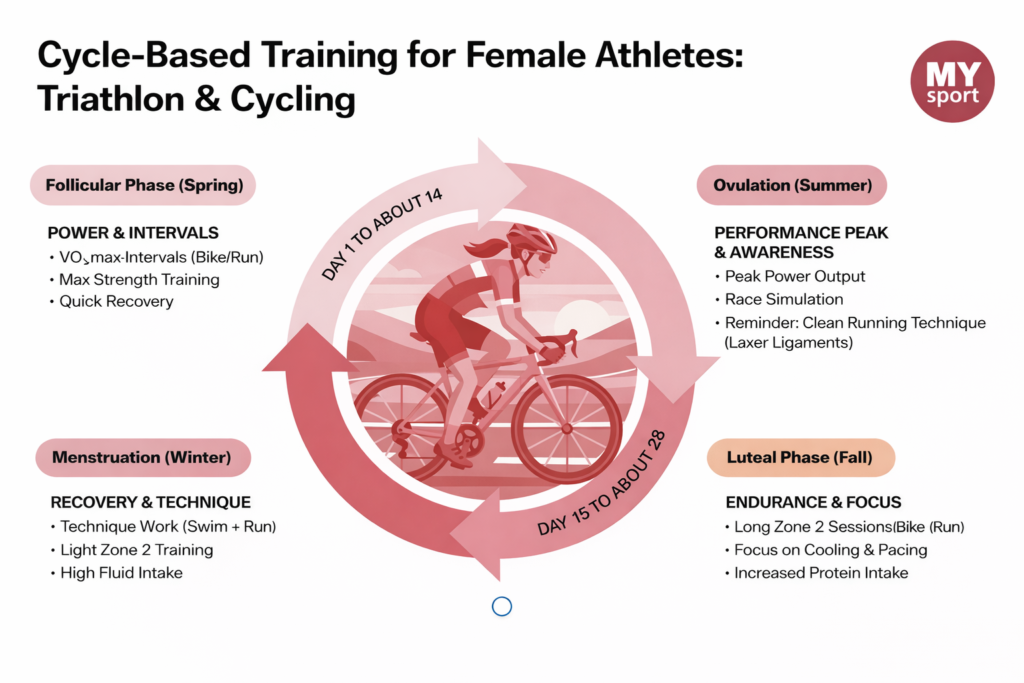
To truly understand your body in training, you need to understand its hormonal phases. The cycle begins on the first day of menstruation and can be broadly divided into two main phases, separated by ovulation.
The Follicular Phase (Day 1 to approx. Day 14) – Your Power Phase
After menstruation, estrogen levels rise steadily. Estrogen has an anabolic effect, meaning it supports muscle building. During this phase, your body is particularly resilient.
- Metabolism: Your body can utilize carbohydrates more efficiently.
- Training: The ideal time for high-intensity intervals (HIIT), sprints, and heavy strength training sessions.
- Recovery: Your body recovers from high loads more quickly.
Ovulation – Peak Performance
Shortly before and during ovulation, estrogen reaches its peak. Many athletes report their highest levels of strength and energy during this time.
A word of caution: Studies suggest that under high estrogen levels, ligaments and tendons may be slightly less stable. Pay close attention to proper technique, especially during cycling sprints or trail running.
The Luteal Phase (Day 15 to approx. Day 28) – Endurance and Focus
After ovulation, progesterone takes the lead. Your body prepares for a potential pregnancy, bringing along several physiological changes:
Focus: During this phase, longer low-intensity endurance sessions (Zone 2) take priority. Your body increasingly relies on fat as an energy source. Recovery also becomes especially important.
Body temperature: This increases by approximately 0.3–0.5 °C (0.5–0.9 °F), making training in the heat more demanding.
Breathing: Progesterone stimulates respiration, meaning you may feel out of breath more quickly at the same level of effort.
Training in Practice: When to Push, When to Dial It Back
Theory is the foundation—but what does this actually look like in practice? Cycle-based training doesn’t mean doing only yoga in the second half of your cycle. It’s about adjusting intensity to your body and your cycle, and working with your physiology rather than against it. This is always an individual process.
Power Weeks (Follicular Phase)
In the first half of your cycle, hormonally speaking, you are most comparable to a man. This means your hormonal environment is stable and relatively low. Use this to your advantage.
Competitions: Many personal bests are achieved in the late follicular phase, just before ovulation.
Interval training: This is the ideal time for VO₂max intervals on the bike or high-intensity running sessions.
Strength training: Your body responds exceptionally well to training stimuli. Focus on building maximal strength.
Strategic Adjustment (Luteal Phase)
In the phase after ovulation, your body works against a higher internal resistance. This is especially noticeable in the late luteal phase—just before menstruation—when the physiological load is at its peak.
Base endurance: Longer, low-intensity sessions (Zone 2) are usually more effective than high-intensity efforts.
Technique focus: As coordination and body awareness can be slightly affected by progesterone, this is a great time to focus on technique work in the water or on the bike.
Cooling: Since your core body temperature is elevated, make sure to use a strong fan during indoor sessions and stay well hydrated. Outdoors, consider cooling vests or training during cooler times of the day.
The Red Flag: Nutrition & RED-S Syndrome
A key factor in women’s health in sport is energy availability. If you train hard but don’t provide your body with enough energy (calories), it shifts into a conservation mode.
What is RED-S?
Relative Energy Deficiency in Sport (RED-S) describes a state in which energy intake is insufficient to support both training and essential bodily functions. In women, the first system the body downregulates is the reproductive system.
Cycle loss: The absence of menstruation (amenorrhea) is not a sign of hard training to be proud of—it is a warning signal of energy deficiency.
Bone health: Without menstruation, there is insufficient estrogen. Without estrogen, bone density declines significantly. Stress fractures are often the result.
Performance decline: Chronically under-fueling leads to decreased performance, impaired recovery, and a higher susceptibility to infections.
Adjusting Your Nutrition
In the luteal phase, your resting metabolic rate is slightly elevated. At the same time, your body increases protein breakdown (catabolic state).
Tip: Pay particular attention to adequate protein intake in the second half of your cycle, and never eliminate carbohydrates before intense sessions. Your body needs them more than ever, as hormonal changes make it harder to access glycogen stores.
Tracking & Individuality: Become the Expert of Your Own Body
Science provides the framework—but every athlete is unique. A “standard” 28-day cycle is rarely the reality. Cycles can become longer and more irregular, especially with age. That’s why monitoring is the most important step in successfully implementing cycle-based training.
Cycle tracking: Use apps (Garmin, Whoop) or a traditional training journal. Track not only your period, but also symptoms such as energy levels, sleep quality, mood, digestion, and muscle soreness.
Body awareness vs. data: After three to four months, you’ll start to recognize patterns. You might notice that you feel particularly fatigued three days before your period—this is your signal to proactively adjust or reschedule a planned key session.
Communication: If you’re working with a coach, address this topic openly. A professional training plan should be flexible enough to account for your hormonal state.
5. The Transition: Performance After 40
In endurance sports, progress often means adapting to new conditions. If you want to continue chasing personal bests in triathlon or cycling beyond the age of 40, you need to strengthen your hormonal resilience. During this phase, the physiological foundations of endurance and strength change significantly.
Here are the key phases every female athlete should understand:
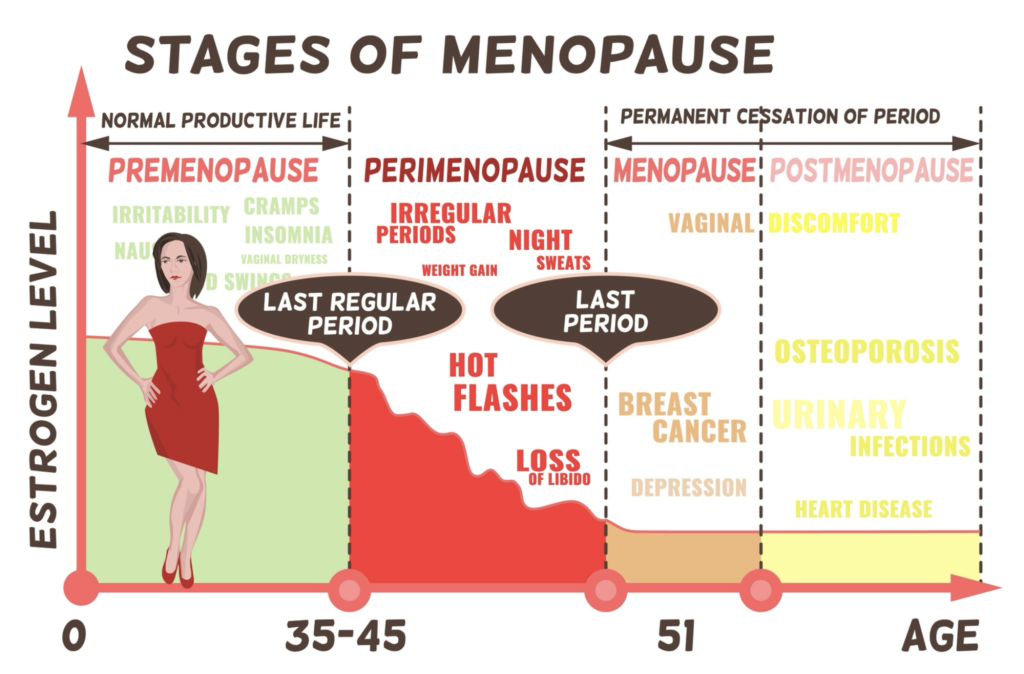
Premenopause: The phase of regular fertility with stable cycles. Training follows the classic pattern (follicular/luteal phase).
Perimenopause: The “hormonal transition.” Progesterone—and later estrogen—production becomes irregular. Cycles may shorten or disappear. Triathlon check: Recovery capacity can fluctuate significantly—metrics like HRV and sleep quality become your most important guides.
Menopause: The point at which your last menstruation was 12 months ago.
Postmenopause: The period after menopause. Hormones stabilize at a low but consistent level. Cyclical fluctuations disappear, allowing for a new level of consistency and predictability in training.
Adjusting Your Training
Bone density & strength: As estrogen levels decline, the risk of osteoporosis increases. Since cycling and swimming are not impact sports, they don’t provide sufficient stimulus for bone formation. The solution: Make sure to complement your training with heavy strength training and plyometric exercises to prevent stress fractures (e.g. in the pubic bone or pelvis).
Intensity over endless miles: Long Zone 2 rides in the “no man’s land” of intensity can lead to chronically elevated cortisol levels during perimenopause, which promotes muscle breakdown. Instead, focus on short, high-intensity sprints on the bike or VO₂max intervals when running to keep your metabolism active.
Swim performance & thermoregulation: During perimenopause, thermoregulation (e.g. hot flashes) can be impaired. Swimming offers an advantage through the cooling effect of the water, but should be complemented with targeted technique work, as neuromuscular coordination can be slightly affected by hormonal fluctuations.
Protein timing in brick sessions: In postmenopause, the body’s anabolic (muscle-building) response decreases. To avoid shifting into a catabolic state after a demanding bike-run session, it’s essential to consume high-quality protein (approx. 30g) within 30–60 minutes after training.
Conclusion: Your Cycle as Your Fifth Vital Sign
Cycle-based training is not about complexity for the sake of complexity. It’s about working with your body instead of fighting against it. If your period comes regularly, it’s a sign of adequate energy availability and a healthy hormonal system—the foundation for long-term performance in endurance sports.
Listen to your body, fuel it properly, and use your hormonal waves to create new training stimuli. Your health is your greatest asset for your next competition.
➡️ If you want to align your training, nutrition, and health holistically with your body and your cycle, I’d love to support you through personalized coaching. Find out more here.